Saturday, March 22, 2008



Saturday, March 08, 2008
Sunday, March 02, 2008

Saturday, March 01, 2008
Sunday, February 24, 2008
Thursday, February 21, 2008
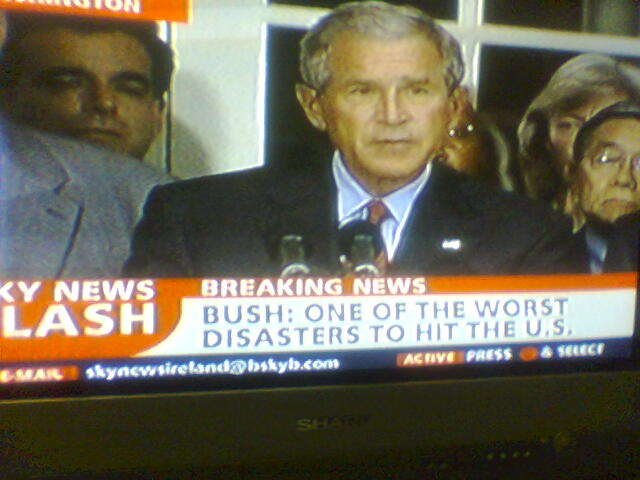
Bush now has worst poll numbers of any President
There is rapidly becoming little dispute that Bush is the Worst President Ever:
George W. Bush's overall job approval rating has dropped to a new low in American Research Group polling as 78% of Americans say that the national economy is getting worse according to the latest survey from the American Research Group.
Among all Americans, 19% approve of the way Bush is handling his job as president and 77% disapprove. When it comes to Bush's handling of the economy, 14% approve and 79% disapprove.
Among Americans registered to vote, 18% approve of the way Bush is handling his job as president and 78% disapprove. When it comes to the way Bush is handling the economy, 15% of registered voters approve of the way Bush is handling the economy and 79% disapprove.
Wednesday, February 20, 2008
Sunday, February 17, 2008
A Modest Proposal
Currently (no pun intended) about 5% of the energy being generated by SaskEnery is wind power. This may not seem like a lot, but it enough to power 7,000 homes.
What about solar?
I have talked about this before, but more and more projects are starting to be designed and proposed that make this a serious alternative.
the latest?
Yes, there would need to be a substantial investment by SaskEnergy, and that would come at the expense of dividends turned over to the province, but really, the NDP left a massive surplus for the Sask Party government to deal with.
The technology is ready. On the following pages we present a grand plan that could provide 69 percent of the U.S.’s electricity and 35 percent of its total energy (which includes transportation) with solar power by 2050. We project that this energy could be sold to consumers at rates equivalent to today’s rates for conventional power sources, about five cents per kilowatt-hour (kWh). If wind, biomass and geothermal sources were also developed, renewable energy could provide 100 percent of the nation’s electricity and 90 percent of its energy by 2100.
And surly this is a better use of money than nuclear. Now, don't get me wrong, I am not in the norm in my party in that I am not philosophically opposed to a nuclear option, but for the same (or lower) investment that was made in wind power for the last 5 years, if SaskEnergy could just set a target of 10% solar-generated electricity, say in 7-10 years, then combined with wind we would have 15% renewable resources.
Add in co-generation, poly-generation and biomass projects and soon we could be looking at 1 in 4 MW being "green"
Now that is a modest proposal
Thursday, February 14, 2008
Blogging Problems
My heart just doesn't seem to be in the whole blogging thing these days. I have been following the American election with a great deal of interest and have made a number of posts, but I find it harder and harder to get motivated to blog each day.
I am still getting about 40 hits a day (even with almost no new posts) so I sort of feel compelled to keep going, if only out of thanks for the audience that I have built up over the last year.
I will try to put some more new content here soon, I promise.
Sunday, February 03, 2008
Eisenhower Endorses Obama
It's like the entire 50's and 60's are coming back to endorse Obama:
Forty-seven years ago, my grandfather Dwight D. Eisenhower bid farewell to a nation he had served for more than five decades. In his televised address, Ike famously coined the term "military-industrial complex," and he offered advice that is still relevant today. "As we peer into society's future," he said, we "must avoid the impulse to live only for today, plundering, for our own ease and convenience, the precious resources of tomorrow. We cannot mortgage the material assets of our grandchildren without risking the loss also of their political and spiritual heritage. We want democracy to survive for all generations to come, not to become the insolvent phantom of tomorrow."
Friday, February 01, 2008
Ann Coulter says she will support Clinton over McCain
Apparently Clinton is the true conservative choice:
Thursday, January 31, 2008
Why Obama gets the Youth Vote
Interesting story:
While enthusiastic Democrats of all ages produced a 90% increase in turnout for the first caucuses, the number of young voters was up half again as much: 135%. The kids preferred Obama over the next-closest competitor by more than 4 to 1.
...
Obama is the only candidate in either party who is viewed favorably by a majority of young people, and he has half again as much support as his nearest competitor, Democrat or Republican.
...
In South Carolina, Obama drew more under-30 votes than all Republican candidates combined, according to exit polls.
...
If you want to feel old, just tell a group of teenagers today that you can remember a time when the Clintons were hip. There was this guy on TV, see, called Arsenio Hall, and Bill Clinton went on wearing sunglasses and playing a saxophone, and, well, no, it wasn't on YouTube — this was before most people had heard of the Internet — oh, never mind. There's nothing new, for today's young people, about a Clinton replacing a Bush.
...
His campaign is crawling with cool young people, and the candidate fits right in. We've yet to see Obama flustered or harried; instead, he gives off the enigmatic Zen confidence of the guy who is picked first for every game.
...
He tells young people they can make a difference, and they decide to vote, thus making a difference. "Hope is the thing with feathers," as Emily Dickinson put it, and if Obama can make it fly, it can have deep implications in a society primed to follow the passions of youth.
...
When young people get involved, they tend to stay involved. The graybeards of today's Democratic Party were once the inspired youth of the New Frontier, or Clean for Gene McCarthy, or bell-bottomed foot soldiers for George McGovern. Scan the crowd at an Obama rally, squint, and you just might see the future.
Tuesday, January 29, 2008
The Difference Between Obama and Clinton Summarized
This is a telling section of this story:
Bah.
When Bush proclaimed, “Ladies and gentlemen, some may deny the surge is working, but among terrorists there is no doubt,” Clinton sprang to her feet in applause but Obama remained firmly seated. The president’s line divided most of the Democratic audience, with nearly half standing to applaud and the other half sitting in stony silence.
Sunday, January 27, 2008
Bush at all-time low (again) in polls
The economy and the war in Iraq have brought President Bush's approval numbers to 32% in a new ABC News/Washington Post poll -- the lowest rating of his career for this poll.
Where the press release tells us, "Just 32 percent of Americans now approve of the way Bush is handling his job, while 66 percent disapprove," that's about all we get about it. But the actual breakdown of those responses is very telling. You can look at the full report (PDF) here. Respondents were asked, "Do you approve or disapprove of the way George W. Bush is handling his job as president? Do you approve/disapprove strongly or somewhat?" The responses worked out this way:
-Strongly approve: 16%
-Somewhat approve: 16%
-Somewhat disapprove: 15%
-Strongly disapprove: 51%
In other words a majority of Americans strongly disapprove of Bush. Not since Truman has that been the case and these low numbers for Bush have been stuck there for months (since last pril when he tied Truman for low numbers)
Thursday, January 24, 2008
Super Tuesday won't finish the race
There is an interesting analysis here about the proportion of delegates that the Democratic Contenders might get based on polling numbers.
The conclusion?
If these numbers hold true, and the candidates split the remaining 350 delegates which the polling doesn't account for, the Democratic primary season seems likely to continue well beyond February 5th. The fact that 20% of all delegates come in the form of superdelegates means that a candidate would have to amass more than 62% of the delegates awarded during primaries to secure the nomination without help from superdelegates.
...
Further complicating matters is the fact that Democrats don't hold winner-take-all primaries, making a breakaway lead in delegates by any one candidate very hard to accomplish. Moreover, Edwards continues to make clear his intentions to stay in the race through the convention -- knowing that a few hundred delegates might swing the nomination to either Clinton or Obama -- putting him in the position of "kingmaker". While serious momentum swings are possible in the lead-up to Super Tuesday which could strongly tilt the race to one candidate, there's no hint of it. And since both Clinton and Obama continue to be able to fundraising at very high levels, this race is giving every indication that we should settle in for one of the longer primaries battles in a generation.
This seems to agree with the Associated Press analysis here:
We could be in for a loner race than most.
Don't look to crown any presidential nominees on Super Tuesday. The race for delegates is so close in both parties that it is mathematically impossible for any candidate to lock up the nomination on Feb. 5, according to an Associated Press analysis of the states in play that day.
Wednesday, January 23, 2008
Why the Manely Report is Misguided
This article is more about Iraq than Afghanistan, but there are some telling similarities.
Not true.
Events have (yet again) reached a turning point. There, at the far end of the tunnel, light flickers. Despite the hand-wringing of the defeatists and naysayers, victory beckons.
Same with Manley's discussion about 2000 more troops. this is just a surge by any other name.
By shifting the conversation to tactics, they seek to divert attention from flagrant failures of basic strategy. Yet what exactly has the surge wrought? In substantive terms, the answer is: not much.
And so on...
A nation-building project launched in the confident expectation that the United States would repeat in Iraq the successes it had achieved in Germany and Japan after 1945 instead compares unfavorably with the U.S. response to Hurricane Katrina. Even today, Iraqi electrical generation meets barely half the daily national requirements. Baghdad households now receive power an average of 12 hours each day -- six hours fewer than when Saddam Hussein ruled.
Again, replace "Iraq" with Afghanistan and the comparison is startling.
In short, the surge has done nothing to overturn former secretary of state Colin Powell's now-famous "Pottery Barn" rule: Iraq is irretrievably broken, and we own it. To say that any amount of "kicking ass" will make Iraq whole once again is pure fantasy. The U.S. dilemma remains unchanged: continue to pour lives and money into Iraq with no end in sight, or cut our losses and deal with the consequences of failure.
Monday, January 21, 2008


Sunday, January 20, 2008
Hmmm....Think there's an election coming in Alberta?
Albertans for Change http://albertansforchange.com/
Ads - now running on television.
365 Days left of Bush

On January 20, 2009 a new president will be sworn in.
Thank god.
Can't wait for him to finally be gone.
Beset by growing economic concerns on top of the long unpopular war in Iraq, President Bush starts the last year of his presidency with the worst approval rating of his career.
...
Bush is just two months away from Truman's record of 38 months without majority approval -- far beyond any other.
...
Intensity of sentiment, moreover, remains very heavily against the president. Fifty-one percent strongly disapprove of his work overall, while just 16 percent strongly approve -- strongly negative by better than a 3-1 ratio.
...
Among those who disapprove of the war, Bush's approval rating is 12 percent; "wrong track," 91 percent.
...
Republican self-identification has moved back down, to an average of 25 percent across 2007 -- its lowest yearlong average since 1984.
...
Bush is at career lows in approval in three groups as well as overall -- among liberals (9 percent approve of his work), moderates (24 percent) and independents -- the center of American politics -- among whom just 25 percent approve.
Subscribe to:
Posts (Atom)